Edenbridge Primary School
The Pioneer Academy
Family of Schools
-

The Pioneer Academy
-

Stewart Fleming Primary School
-

Red Hill Primary School
-

Downe Primary School
-

Southborough Primary School
-
Belvedere Infant School
-

Belvedere Junior School
-

Burnt Oak Junior School
-

Chatsworth Infant School
-

Broadmead Primary School
-

South Norwood Primary School
-
The Crescent Primary School
-

Woodcote Primary School
-

Edenbridge Primary School
-

Halstead Community Primary School
-

Holland Junior School
-
Shoreham Village School
-

Ightham Primary School
-

Moulsecoomb Primary School
-

West Blatchington Primary & Nursery School
-

Hollington Primary School
Computing
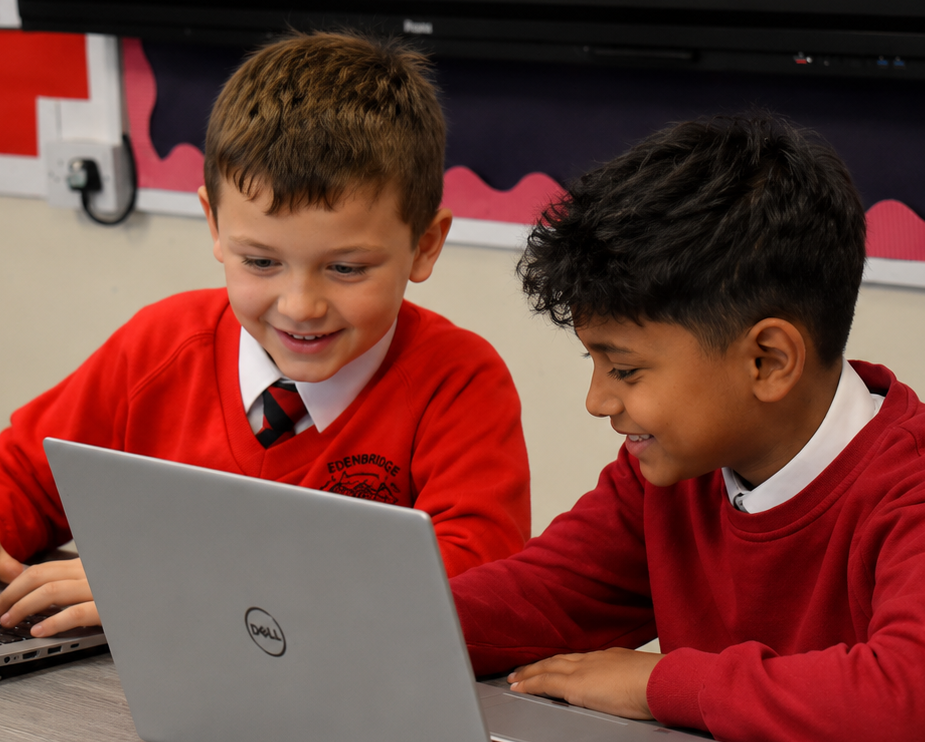
Computing at Edenbridge Primary School
Intent
Our Computing Curriculum embodies our values of:
Respect and kindness by ensuring children are responsible, competent, confident and creative users of information and communication technology.
Honesty by engaging and inspiring the children to evaluate and apply information technology, including new or unfamiliar technologies, analytically to solve problems.
Courage by challenging children to analyse problems in computational terms, and have repeated practical experience of writing computer programs in order to solve such problems.
Responsibility by using computing to inspire, engage and challenge the children to respect technology.
We incorporate, wherever possible, the work within the topics making links with other curriculum areas as computing has deep links with mathematics, science, and design and technology.
Implementation
Key skills and knowledge for computing have been mapped across the school to ensure progression across the key stages in two year cycles. The lessons are taught using PurpleMash Scheme of Work.
At Edenbridge Primary School children in key stage 1 will be taught to:
- understand what algorithms are; how they are implemented as programs on digital devices; and that programs execute by following precise and unambiguous instructions
- create and debug simple programs
- use logical reasoning to predict the behaviour of simple programs
- use technology purposefully to create, organise, store, manipulate and retrieve digital content
- recognise common uses of information technology beyond school
- use technology safely and respectfully, keeping personal information private; identify where to go for help and support when they have concerns about content or contact on the internet or other online technologies.
Then in key stage 2 the children will be taught to:
- design, write and debug programs that accomplish specific goals, including controlling or simulating physical systems; solve problems by decomposing them into smaller parts
- use sequence, selection, and repetition in programs; work with variables and various forms of input and output
- use logical reasoning to explain how some simple algorithms work and to detect and correct errors in algorithms and programs
- understand computer networks including the internet; how they can provide multiple services, such as the world wide web; and the opportunities they offer for communication and collaboration
- use search technologies effectively, appreciate how results are selected and ranked, and be discerning in evaluating digital content
- select, use and combine a variety of software (including internet services) on a range of digital devices to design and create a range of programs, systems and content that accomplish given goals, including collecting, analysing, evaluating and presenting data and information
- use technology safely, respectfully and responsibly; recognise acceptable/unacceptable behaviour; identify a range of ways to report concerns about content and contact
Impact
Through our Computing curriculum, the children will:
- be taught the principles of information and computation
- know how digital systems work
- know how to put this knowledge to use through programming
- use information technology to create programs, systems and a range of content
- be able to use, and express themselves and develop their ideas through, information and communication technology
Therefore, our curriculum will equips children to use computational thinking and creativity to understand and change the world. They will become digitally literate at a level suitable for the future workplace and as active participants in a digital world.
E Safety
The development of the ‘E’ Safety policy ensures a robust approach to safeguarding children and staff in using the Internet safely and responsibly. The detailed policy is in line with Government Guidance and provides an aide memoire to all stakeholders about the use of e-mail, dangers of cyber bullying and the robust permissions required to safeguard children. Underpinning everything we do in Computing is E Safety. Each term starts with an E-safety lesson, focusing on safety aspects of the unit, to teach the children how to stay safe onine. Children are continually reminded throughout each lesson and within their daily lives the importance of E Safety.